Fresh loaves ready for pick up every Friday

A clear, baker‑friendly guide to help you add inclusions
Here’s a clear, baker‑friendly guide to help you add inclusions with confidence to your sourdough
4/16/20263 min read


How to Add Inclusions to Sourdough Bread (Without Ruining Your Dough)
Adding inclusions — chocolate, nuts, seeds, herbs, dried fruit, cheese, roasted garlic, you name it — is one of the most fun ways to personalize your sourdough. But inclusions also change the dough’s behavior. They bring sugar, salt, and moisture, and each of those elements affects fermentation, gluten strength, and overall structure.
Here’s a clear, baker‑friendly guide to help you add inclusions with confidence.
Why Inclusions Change Your Dough
Sourdough is a living system. Anything you add to it will influence:
Fermentation speed
Gluten development
Hydration balance
Salt concentration
Crumb structure
Understanding these variables helps you avoid gummy centers, weak gluten, or over‑proofing — and instead bake loaves that are flavorful, balanced, and beautifully structured.
1. Sugar: The Fermentation Accelerator
Sugar‑containing inclusions (dried fruit, chocolate, honey, jams, sweetened coconut, etc.) speed up fermentation because wild yeast loves simple sugars.
What this means for your dough:
Your bulk fermentation may move faster
Dough can over‑proof more easily
The crumb may become softer or more tender
The crust may brown more quickly
Tips:
Add sugary inclusions late in bulk to avoid over‑fermentation. I often add sugar during lamination at shaping. Be careful not to let the sugar get to close to the edge. It like to turn into a yummy sugary syrup that is best kept INSIDE the loaf.
Reduce dough temperature slightly if needed
Watch the dough, not the clock — it will rise faster
2. Salt: The Fermentation Slower
Salted inclusions (olives, salted nuts, cheese, cured meats) slow fermentation and can tighten gluten.
What this means:
Dough may rise more slowly
Gluten may feel firmer
Hydration may feel slightly lower
Tips:
Don’t increase your base dough salt — the inclusions already contribute
If using very salty ingredients (feta, olives), rinse and pat dry. You may even consider lowering the added salt content in the dough.
Expect a slightly longer bulk fermentation
3. Moisture: The Hidden Hydration Factor
Some inclusions bring extra water (fresh fruit, roasted vegetables, soaked grains), while others absorb water (nuts, seeds, oats).
Moisture‑adding inclusions:
Can make dough sticky or slack
May require reducing hydration by 2–5%
Should be added well‑drained and patted dry
Moisture‑absorbing inclusions:
Can make dough feel tighter
May require increasing hydration by 2–5%
Benefit from pre‑soaking (seeds, oats, grains). Get creative with your pre-soaking. You can level up the flavor by using items like juice, coffee or sauce.
4. When to Add Inclusions
The best time is usually after the first set of stretch‑and‑folds, when gluten has begun to form but the dough is still relaxed. This timing is nuanced and requires more in depth discussion. Inclusions change the dough’s structure, fermentation speed, and hydration. Adding them at the right time keeps your crumb open, your gluten strong, and your loaf beautifully shaped.
The next question then is... what goes in when?
Add These Late in Bulk Fermentation
Late bulk (after the first or second fold) is ideal for inclusions that:
Could disrupt gluten if added too early
Contain sugar that speeds fermentation
Are soft, sticky, or prone to smearing
Need gentle, even distribution
Best inclusions for late bulk:
Dried fruit (raisins, cranberries, cherries, apricots) High sugar → speeds fermentation; add late to avoid over‑proofing.
Chocolate chips or chunks Prevents melting into the dough early on.
Soft cheeses (cheddar, gouda, mozzarella) Keeps them from breaking down during early fermentation.
Fresh herbs (rosemary, thyme, basil) Avoids tearing gluten early.
Cinnamon sugar swirls Sugar weakens gluten; add late to maintain structure.
Toasted nuts (walnuts, pecans, pistachios) Avoids tearing gluten during early development.
Seeds (sunflower, pumpkin, sesame) Especially if not pre‑soaked.
Why late bulk works:
Gluten is already partially developed
Dough is still extensible enough to laminate
Inclusions distribute evenly without tearing
Add These During Shaping
Some inclusions are best added right at shaping because they:
Are very wet
Are very salty
Could interfere with fermentation
Need to stay visually distinct (swirls, layers, pockets)
Best inclusions for shaping:
Roasted garlic cloves Very moist; can weaken gluten if added too early.
Sugar and Cinnamon dissolves into sugary syrup if added too early.
Roasted vegetables (onions, peppers, squash) High moisture → add during shaping to avoid slack dough.
Fresh fruit (apples, berries, pears) Juicy ingredients can collapse gluten if added earlier.
Olives Salty + wet → slows fermentation and adds moisture.
Feta or brined cheeses Salt + moisture → best added at shaping.
Jam or fruit compote swirls Keeps the swirl defined and prevents sugar from over‑fermenting the dough.
Cured meats (salami, prosciutto, pepperoni) High salt → slows fermentation; add late to keep dough balanced.
Why shaping works:
You can laminate or roll inclusions into distinct layers
Moisture stays contained
Salt doesn’t interfere with bulk fermentation
You maintain dough strength
Quick Rule of Thumb
Sugary, sticky, or fragile inclusions → late bulk Wet, salty, or swirl‑style inclusions → shaping
Why:
Dough is strong enough to hold mix‑ins
You avoid tearing gluten early
Inclusions distribute more evenly
Gently laminate or fold them in — don’t knead.
5. Popular Sourdough Inclusions
Here are some favorites that behave well in dough:
Sweet:
Chocolate chunks
Dried cranberries, cherries, raisins
Cinnamon sugar swirls
Orange zest
Toasted coconut
Savory:
Cheddar, gruyere, parmesan
Roasted garlic
Jalapeños
Olives
Sun‑dried tomatoes
Herbs (rosemary, thyme, basil)
Nutty & Seedy:
Walnuts, pecans, pistachios
Pumpkin seeds, sunflower seeds
Sesame, poppy, flax
Soaked oats
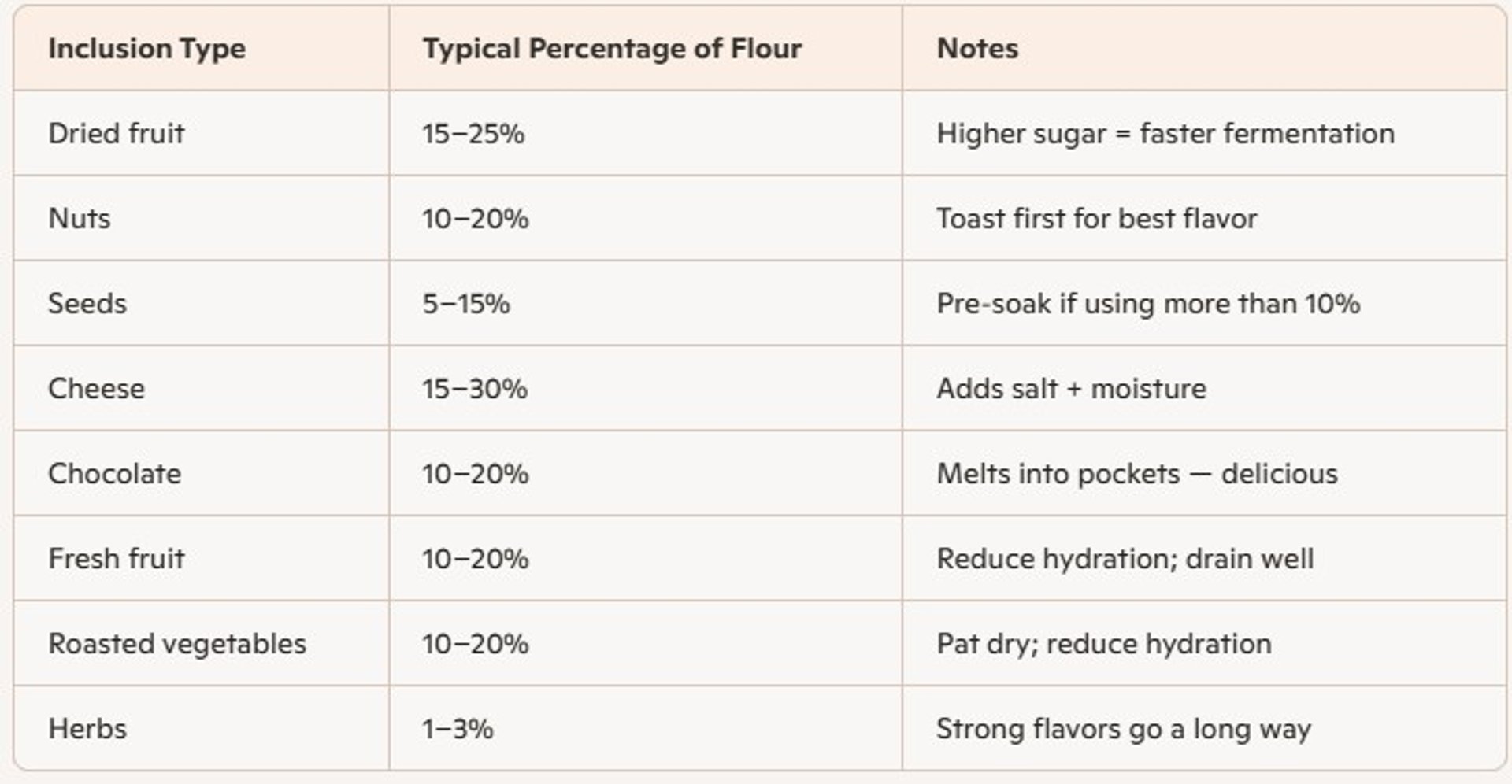
6. Inclusion Percentage Guide (Baker’s Percentages)
Below is a simple table to help you calculate how much to add based on your flour weight. This keeps your dough balanced and prevents overloading.
Recommended Inclusion Percentages
Kate's Pasture to Pantry
At our sourdough bakery, we believe great bread begins with simple, honest ingredients.
Food Handler card holder Oregon Cottage Law Compliant
Contact
Newsletter
Katespasturetopantry@gmail.com
503-703-3783
© 2024. All rights reserved.